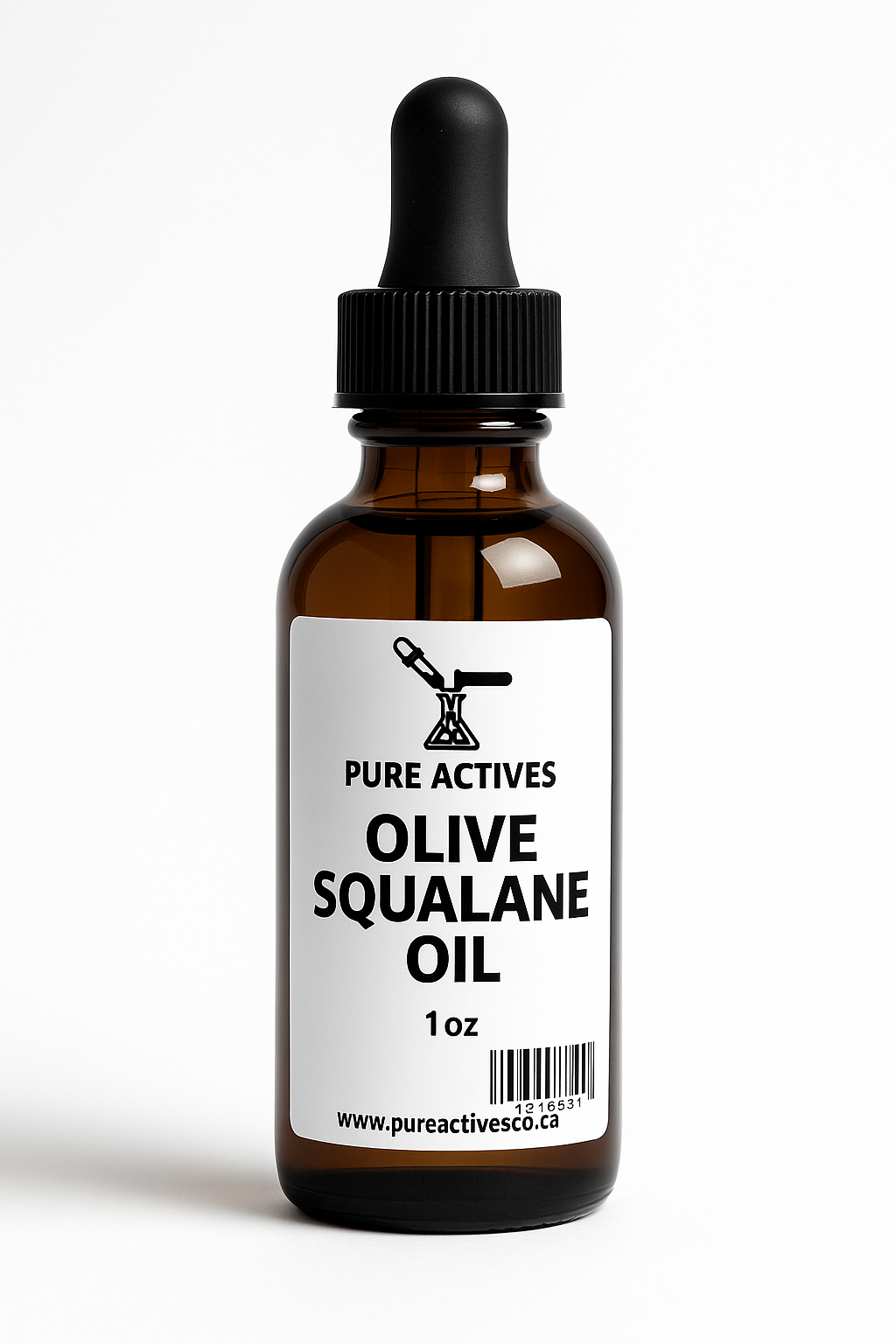
What Is Olive Squalane Oil?
Squalane is a saturated hydrocarbon derived from squalene — a lipid naturally produced by human sebaceous glands and found abundantly in olive oil. Our Olive Squalane Oil is produced through the hydrogenation of olive-derived squalene, converting it into a highly stable, odourless, colourless, and exceptionally skin-compatible emollient that closely mimics the skin’s own natural lipids.
If you’re new to formulating, here’s why squalane is beloved: it feels like nothing on skin. It absorbs almost instantly, leaves zero greasiness, and plays well with every other ingredient. It’s non-comedogenic, pH-neutral, and suitable for literally every skin type — from dry and mature to oily and acne-prone. It’s also one of the most stable oils you can use, which means it won’t go rancid and won’t destabilize your formula.
For experienced formulators: Olive Squalane is a C30 isoparaffin-class emollient with excellent oxidative stability (no unsaturated bonds), making it an ideal carrier and co-emollient in sensitive, high-antioxidant, or retinoid-based formulas where oxidative rancidity from other oils would be a concern. Its low viscosity and high spreadability make it a versatile oil-phase ingredient across emulsions, anhydrous serums, facial oils, and hair care formats. It also functions as an effective solvent for lipid-soluble actives such as Tetrahexyldecyl Ascorbate, Bakuchiol, and oil-soluble antioxidants.
Key Benefits
-
Lightweight, fast-absorbing emollient — leaves no greasy or heavy residue; ideal for all skin types including oily and acne-prone
-
Deeply moisturizing — replenishes the lipid layer, reduces transepidermal water loss (TEWL), and improves skin softness and suppleness
-
Non-comedogenic — won’t clog pores; safe for sensitive, reactive, and breakout-prone skin
-
Exceptional oxidative stability — fully saturated structure means it won’t go rancid, extending shelf life of finished formulas
-
Anti-aging — supports skin elasticity and helps reduce the appearance of fine lines by restoring the skin’s lipid barrier
-
Soothing and anti-inflammatory — calms irritation, redness, and environmentally stressed skin
-
Excellent solvent for oil-soluble actives — ideal carrier for retinoids, fat-soluble Vitamin C, Bakuchiol, and antioxidants
-
Hair-compatible — adds shine, reduces frizz, and improves manageability without weighing hair down
-
Natural, sustainable origin — derived from olive, a renewable plant source
Applications
Olive Squalane Oil is one of the most versatile ingredients in cosmetic formulation. Use it in:
- Facial serums and facial oils (as a base or co-ingredient)
- Lightweight moisturizers, lotions, and emulsions (oil phase)
- Anhydrous balms, salves, and treatment oils
- Retinoid and Bakuchiol serums (as a solubilizer and skin-conditioning base)
- Eye creams and under-eye treatments
- Body oils and body lotions
- Hair serums, shine drops, and leave-in treatments
- Lip treatments and lip oils
- Sunscreen formulations (as a lightweight, stable oil-phase component)
Formulation Details
| Property |
Detail |
| INCI Name |
Squalane |
| CAS Number |
111-01-3 |
| Source |
Olive-derived (Olea europaea) |
| Appearance |
Clear, Colourless Liquid |
| Odour |
Odourless |
| Viscosity |
Low — lightweight, fluid texture |
| Solubility |
Oil phase; miscible with other oils and oil-phase ingredients. Not water soluble. |
| Recommended Use Level |
1–99% (as carrier/base); 5–30% typical in emulsions and serums |
| Incorporation Phase |
Oil phase |
| Processing Temperature |
Stable at all cosmetic processing temperatures; no special handling required |
| Oxidative Stability |
Excellent — fully saturated, resistant to rancidity |
| Comedogenicity Rating |
0 — non-comedogenic |
| Grade |
Cosmetic Grade |
| Origin |
Plant-derived — olive (Olea europaea) |
How to Formulate With Olive Squalane Oil
Beginner tip: Squalane belongs in your oil phase. If you’re making a simple facial oil, you can use it as your entire base — just add your oil-soluble actives and you’re done. If you’re making an emulsion (lotion or cream), weigh it into your oil phase alongside your other oils and emulsifiers. It’s foolproof — it won’t separate, go rancid, or cause issues.
Expert notes:
-
Phase: Oil phase. Compatible with all standard cosmetic emulsifiers and oil-phase ingredients.
-
Usage rate: 5–15% in emulsions for a lightweight skin feel; up to 30%+ in richer treatments and facial oils; 100% as a pure facial oil or carrier.
-
As a solvent: Use squalane to dissolve and carry oil-soluble actives that are difficult to incorporate, such as Tetrahexyldecyl Ascorbate (THD Ascorbate), Bakuchiol Oil, and oil-soluble antioxidants.
-
Stability advantage: Unlike many plant oils (rosehip, argan, sea buckthorn), squalane will not oxidize or go rancid. Use it to dilute or extend more unstable oils and extend your formula’s shelf life.
-
Skin feel tuning: Blend with Coco Caprylate/Caprate for an ultra-dry skin feel, or with Isopropyl Myristate for enhanced spreadability.
-
Hair use: Apply 2–5% in leave-in conditioners or hair serums for frizz control and shine without buildup.
Pairings — Build a Better Formula
Squalane is the ultimate team player — it pairs with almost everything. These verified store actives are particularly well-suited:
-
Vitamin E Oil — classic antioxidant pairing; Vitamin E protects squalane and other oils in the formula from oxidation; adds additional skin nourishment
-
Tetrahexyldecyl Ascorbate — oil-soluble Vitamin C; squalane is an ideal carrier for THD Ascorbate in anhydrous and low-water Vitamin C serums
-
Bakuchiol Oil 98% — natural retinol alternative; squalane is the go-to carrier for bakuchiol facial oils and serums — lightweight, non-irritating, and stable
-
Ceramide Powder — skin barrier lipid; use squalane to help solubilize and carry ceramides in barrier-repair formulas
-
Ferulic Acid Powder — phenolic antioxidant; pairs with squalane and Vitamin E/C for a comprehensive antioxidant serum
-
Coco Caprylate/Caprate — dry-feel emollient; blend with squalane to tune skin feel from silky to ultra-dry finish
-
Olive Leaf Extract Powder — botanical synergy; both are olive-derived and complement each other in antioxidant-rich skin treatments
Suggested Formula — Lightweight Bakuchiol Facial Oil
A clean, anhydrous facial oil combining Squalane with Bakuchiol and antioxidant protection — suitable for all skin types including oily and acne-prone.
| Ingredient |
% |
Notes |
| Olive Squalane Oil |
82.0% |
Base carrier |
| Bakuchiol Oil 98% |
10.0% |
Retinol alternative active |
| Tetrahexyldecyl Ascorbate |
5.0% |
Oil-soluble Vitamin C |
| Vitamin E Oil |
2.0% |
Antioxidant stabilizer |
| Ferulic Acid Powder |
0.5% |
Pre-dissolve in a small amount of squalane before adding |
| Fragrance or Essential Oil (optional) |
0.5% |
Optional — use skin-safe, non-comedogenic options |
Method: This is an anhydrous (water-free) formula — no emulsification or heating required. Weigh all ingredients into a clean beaker. Pre-dissolve Ferulic Acid in a small portion of warm squalane first, then combine all ingredients and stir until fully blended. No preservative required for anhydrous formulas. Fill into a dropper bottle.
Note: No preservative is needed for anhydrous (water-free) formulas. If you add any water-based ingredients, a preservative becomes mandatory.
Recommended use: Apply 3–5 drops to cleansed face morning and/or evening. Can be used alone or layered under moisturizer. Always follow with SPF in the AM.
Storage & Shelf Life
- Store in a cool, dry place away from direct sunlight and heat
- Squalane is highly stable — shelf life of 24+ months unopened when stored correctly
- No special storage requirements; does not require refrigeration
- In finished formulas, squalane’s oxidative stability will help extend the overall formula shelf life
Safety & Handling
- For cosmetic/external use only — not for internal consumption
- Avoid contact with eyes; rinse thoroughly with water if contact occurs
- Always conduct a patch test in your finished formulation before use
- Keep out of reach of children
- Refer to the Safety Data Sheet (SDS) for full handling and disposal information