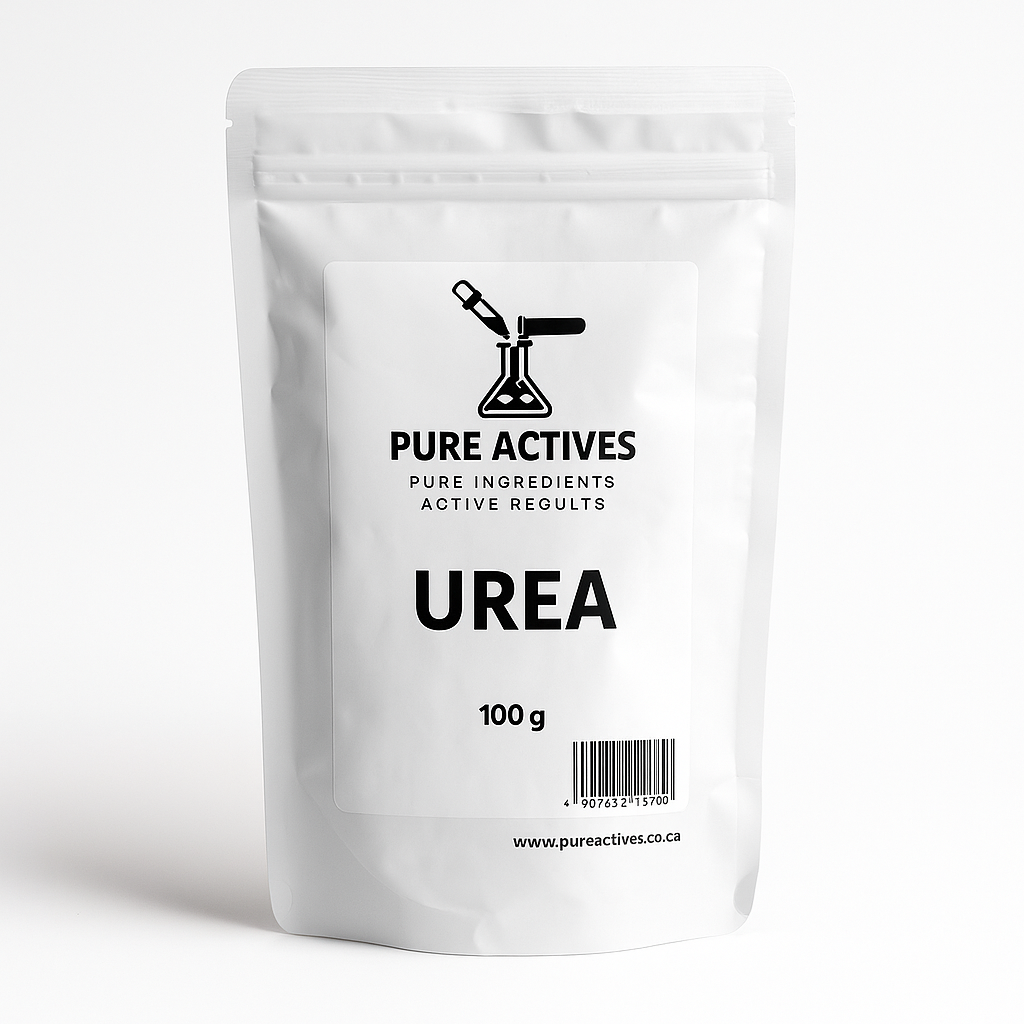
Urea Powder
Professional cosmetic ingredient — not a finished product.
If your moisturizer sits on top of skin instead of sinking in, urea is what’s missing.
Urea is one of the most clinically proven and underutilized actives in cosmetic formulation. It’s a natural component of healthy skin — part of your skin’s own Natural Moisturizing Factor (NMF) — which means it works with your skin’s biology, not against it. When skin is dry, rough, or flaky, it’s often because urea levels have dropped. Adding it back in a lotion, cream, or serum is one of the most effective interventions a formulator can make.
What Is Urea?
Urea (carbamide) is a small, water-soluble molecule that occurs naturally in the stratum corneum as part of the NMF — the collection of compounds that keep skin hydrated, supple, and functional. In cosmetic formulations, it acts through two distinct mechanisms depending on concentration:
-
At 2–5%: Humectant — draws water into the stratum corneum and binds it there, measurably improving skin hydration and reducing transepidermal water loss (TEWL)
-
At 5–10%+: Keratolytic — gently loosens the bonds between corneocytes (dead skin cells), promoting desquamation and smoothing rough, thickened, or hyperkeratotic skin
-
At 20–40%: Intensive keratolytic — used in foot care, callus treatments, and nail softening; clinically effective for conditions like keratoderma and ichthyosis
This dose-dependent versatility makes urea one of the most flexible actives in a formulator’s toolkit — a single ingredient that can serve as a hydrator, exfoliant, or intensive treatment depending on how you use it.
Key Specs
| INCI |
Urea |
| CAS No. |
57-13-6 |
| Appearance |
White crystalline powder, odourless |
| Solubility |
Freely water-soluble; dissolves readily at room temperature |
| Typical Usage Rate |
2–10% (skincare); up to 40% (intensive foot/callus care) |
| pH Stability |
4.0–8.0 (broad compatibility) |
| Processing Temperature |
Add to water phase; do not exceed 70°C to avoid decomposition |
| Grade |
Cosmetic grade; vegan-friendly |
| Shelf Life |
24 months, stored in a cool, dry place |
Key Benefits
-
Deep, lasting hydration — replenishes NMF urea levels in the stratum corneum; measurably improves skin moisture content and reduces TEWL at concentrations as low as 2%
-
Gentle exfoliation — at 5–10%, loosens corneocyte bonds and promotes natural desquamation; smooths rough, flaky, and thickened skin without the irritation of AHAs
-
Penetration enhancer — increases skin permeability, improving the delivery and efficacy of co-formulated actives like Niacinamide, retinol, and Vitamin C
-
Barrier support — restores NMF components, supporting the skin’s natural moisture-retention capacity and reducing sensitivity in compromised skin
-
Broad compatibility — water-soluble, pH-stable across 4–8, compatible with virtually all actives, emulsifiers, and preservative systems
-
Dose-dependent versatility — one ingredient, three distinct functions; adjust concentration to match your product concept
How to Formulate With It
-
Phase: Add to the water phase before or during heating. Dissolves easily in warm or room-temperature water — no pre-dispersion required.
-
Temperature: Keep processing temperature below 70°C to prevent decomposition. Urea is heat-sensitive at prolonged high temperatures.
-
Usage rate:
- 2–5%: Hydrating serums, toners, essences, lightweight lotions
- 5–10%: Body lotions, creams, exfoliating treatments, eczema-prone skin formulas
- 10–20%: Intensive foot creams, heel balms, rough skin treatments
- 20–40%: Callus softeners, nail treatments (professional use)
-
pH: No special adjustment needed for most formulas — stable across pH 4.0–8.0. If combining with AHAs, adjust pH to your acid’s optimal range.
-
Preservation: Compatible with all standard preservative systems. Ensure your preservative is effective at your target pH.
Beginner formula: Dissolve 5% Urea + 5% Glycerin in distilled water, add 0.1% Sodium Hyaluronate at cool-down, preserve with 0.8% Euxyl PE 9010, adjust pH to 5.5. This simple hydrating serum outperforms most commercial moisturizers at a fraction of the cost.
Applications
- Hydrating serums and essences (2–5%)
- Body lotions and creams (5–10%)
- Foot creams and heel balms (10–20%)
- Eczema, psoriasis, and dry skin relief formulas
- Exfoliating treatments and body scrub bases
- Scalp treatments and anti-dandruff formulas
- Nail softening and cuticle treatments
Pairings & Suggested Formulas
-
Panthenol — pair with DL-Panthenol Powder or D-Panthenol Liquid for a dual-action hydration + barrier repair system; urea draws water in, panthenol seals and repairs
-
Niacinamide — combine with Niacinamide Vitamin B3 Powder for a barrier-strengthening, pore-refining body or face lotion; urea’s penetration-enhancing effect boosts niacinamide delivery
-
Lactic Acid — layer with lactic acid for a synergistic exfoliating + hydrating formula; both are NMF components and work complementarily at low pH
-
Hyaluronic Acid — combine with Hyaluronic Acid for a multi-depth hydration system: HA at the surface, urea deeper in the stratum corneum
-
Allantoin — add allantoin at 0.5% for enhanced soothing and skin-smoothing in sensitive or compromised skin formulas
Example formula: A 10% Urea + 3% DL-Panthenol + 5% Glycerin intensive body lotion — dissolve urea and panthenol in warm water phase, emulsify with a simple HLB-matched emulsifier blend, preserve with 0.8% Euxyl PE 9010, pH 5.5–6.0. Ideal for dry, eczema-prone, or post-procedure skin.
Storage & Safety
Store tightly sealed in a cool, dry place away from direct light and heat. Shelf life: 24 months when properly stored. For external use only in finished cosmetic formulations. Not for internal use. Consult SDS before use.