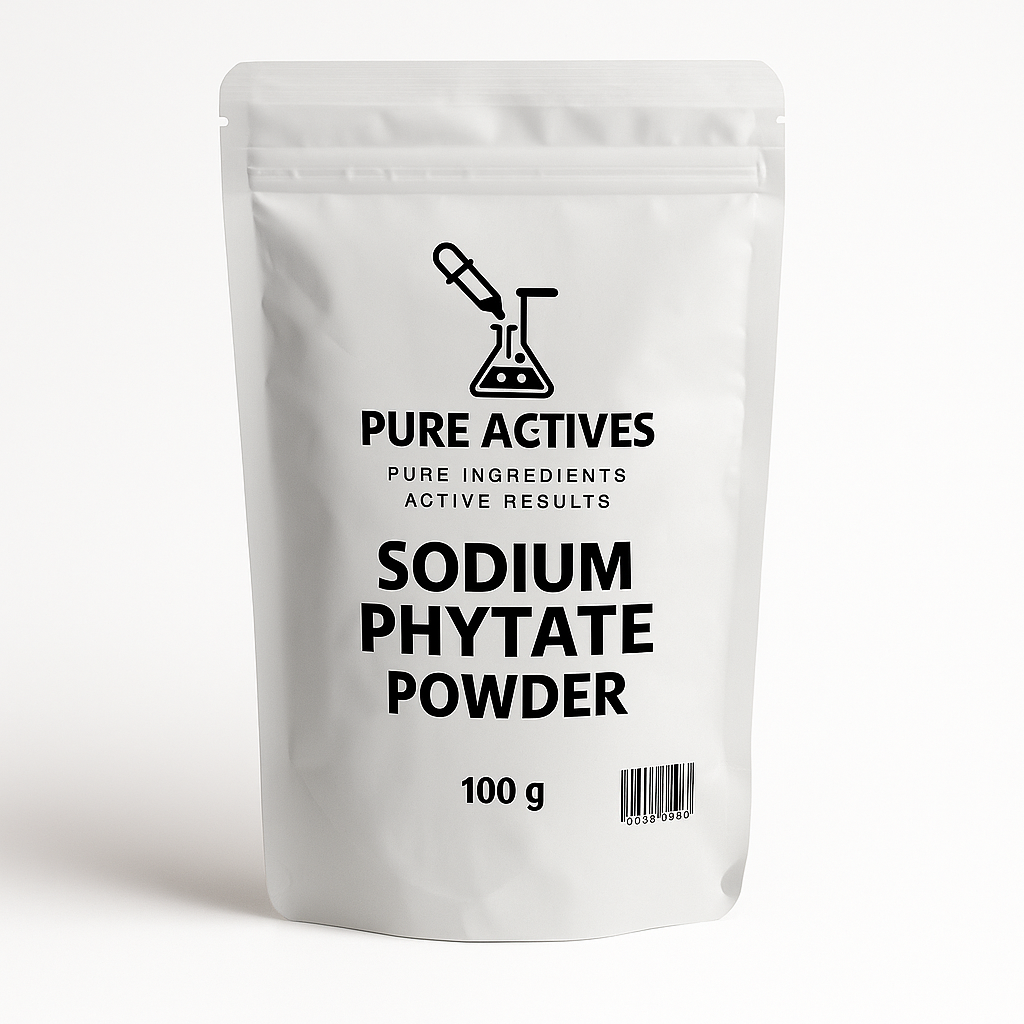
Sodium Phytate
Professional cosmetic ingredient — not a finished product.
Most formulators focus on their actives and emollients — and then wonder why their formula turns yellow, loses fragrance, or fails preservation challenge testing. The culprit is almost always trace metal ions: iron, copper, and calcium naturally present in water and raw materials. Sodium Phytate is the clean-beauty answer. A 100% plant-derived chelating agent sourced from rice bran, it binds those rogue metal ions before they can trigger oxidation, discoloration, or preservative failure — quietly protecting everything else in your formula.
What Is Sodium Phytate?
Sodium Phytate is the sodium salt of phytic acid (inositol hexaphosphoric acid), a naturally occurring compound found in the bran of grains and legumes. As a chelating agent, it forms stable complexes with divalent and trivalent metal ions (Fe²⁺, Cu²⁺, Ca²⁺, Mg²⁺), effectively sequestering them and preventing them from catalyzing oxidative reactions in your formula.
Unlike synthetic chelators such as Disodium EDTA, Sodium Phytate is biodegradable, eco-certified, and fully compatible with natural and organic formulation standards (COSMOS, NATRUE, Ecocert). It is the go-to chelator for clean-beauty, green, and sensitive-skin product lines.
Key Specs
| INCI |
Sodium Phytate |
| CAS No. |
14306-25-3 |
| Appearance |
White to off-white powder |
| Solubility |
Water-soluble; dissolves readily in the water phase |
| Typical Usage Rate |
0.05–0.2% (most formulas use 0.1%) |
| pH Compatibility |
Broad; effective across pH 4.0–8.0 |
| Processing |
Add to water phase; heat-stable up to 80°C |
| Grade |
Cosmetic grade; vegan, biodegradable |
| Certifications |
COSMOS/Ecocert approved |
Why Formulators Use It
-
Prevents oxidation and rancidity — sequesters pro-oxidant metal ions that degrade oils, vitamins, and actives over time; extends shelf life measurably
-
Boosts preservative efficacy — metal ions can neutralize preservatives; chelation restores their full antimicrobial activity, especially in natural systems using sodium levulinate, sodium anisate, or phenoxyethanol
-
Improves formula clarity and stability — prevents metal-induced cloudiness, color shifts, and fragrance degradation in emulsions, serums, and toners
-
Clean-beauty compliant — a direct, biodegradable alternative to EDTA for formulators working within COSMOS, Ecocert, or natural certification frameworks
-
Skin-compatible — gentle, non-irritating at cosmetic use levels; suitable for sensitive skin formulations
How to Use It in Your Formula
-
Phase: Add to the water phase at the start of your process. Dissolves easily in room-temperature or warm water.
-
Usage rate: 0.05–0.2%; 0.1% is the standard starting point for most formulas. Higher rates (up to 0.2%) for formulas with high oil content or complex preservative systems.
-
Preservative pairing: Combine with sodium levulinate + sodium anisate for a fully natural, broad-spectrum preservation system. Also compatible with Euxyl PE 9010, Optiphen, and phenoxyethanol-based systems.
-
pH: No special pH adjustment required — effective across the full cosmetic pH range (4.0–8.0).
-
Heat: Stable up to 80°C; can be added at the beginning of the water phase without concern.
Tip for beginners: Think of Sodium Phytate as insurance for your formula. At 0.1%, it costs almost nothing per batch but protects your actives, your preservative, and your finished product’s appearance and stability. Add it to every water-based formula as a baseline.
Applications
- Serums and essences (especially Vitamin C, retinol, and niacinamide formulas where oxidation is a concern)
- Emulsions — lotions, creams, and milks
- Toners and hydrosol-based products
- Shampoos, conditioners, and scalp treatments
- Natural and organic certified formulations
- Sensitive skin and baby care products
Pairings & Suggested Formulas
Sodium Phytate works synergistically with:
-
Vitamin C actives — pair with 3-O-Ethyl Ascorbic Acid or L-Ascorbic Acid; chelation is critical for Vitamin C stability, preventing the metal-catalyzed oxidation that turns serums brown
-
Niacinamide — add to any Niacinamide formula to prevent the yellowing that occurs when niacinamide reacts with trace metals at elevated temperatures
-
Natural preservative systems — combine with sodium levulinate/anisate blends for a fully COSMOS-compliant preservation system; chelation significantly improves their efficacy against gram-negative bacteria
-
Alpha-Arbutin — use alongside Alpha-Arbutin in brightening serums to protect against metal-catalyzed degradation and browning
Example formula: A stable brightening serum — 0.1% Sodium Phytate + 2% Niacinamide + 1% Alpha-Arbutin + 2% Tranexamic Acid in a water/glycerin base, preserved with 0.8% Euxyl PE 9010, pH adjusted to 5.5. Add Sodium Phytate first to the water phase, then dissolve actives in order of concentration.
Storage & Safety
Store tightly sealed in a cool, dry place away from direct light and heat. Shelf life: 24 months when properly stored. For external use only in finished cosmetic formulations. Not for internal use. Wear appropriate PPE when handling powders. Consult SDS before use.