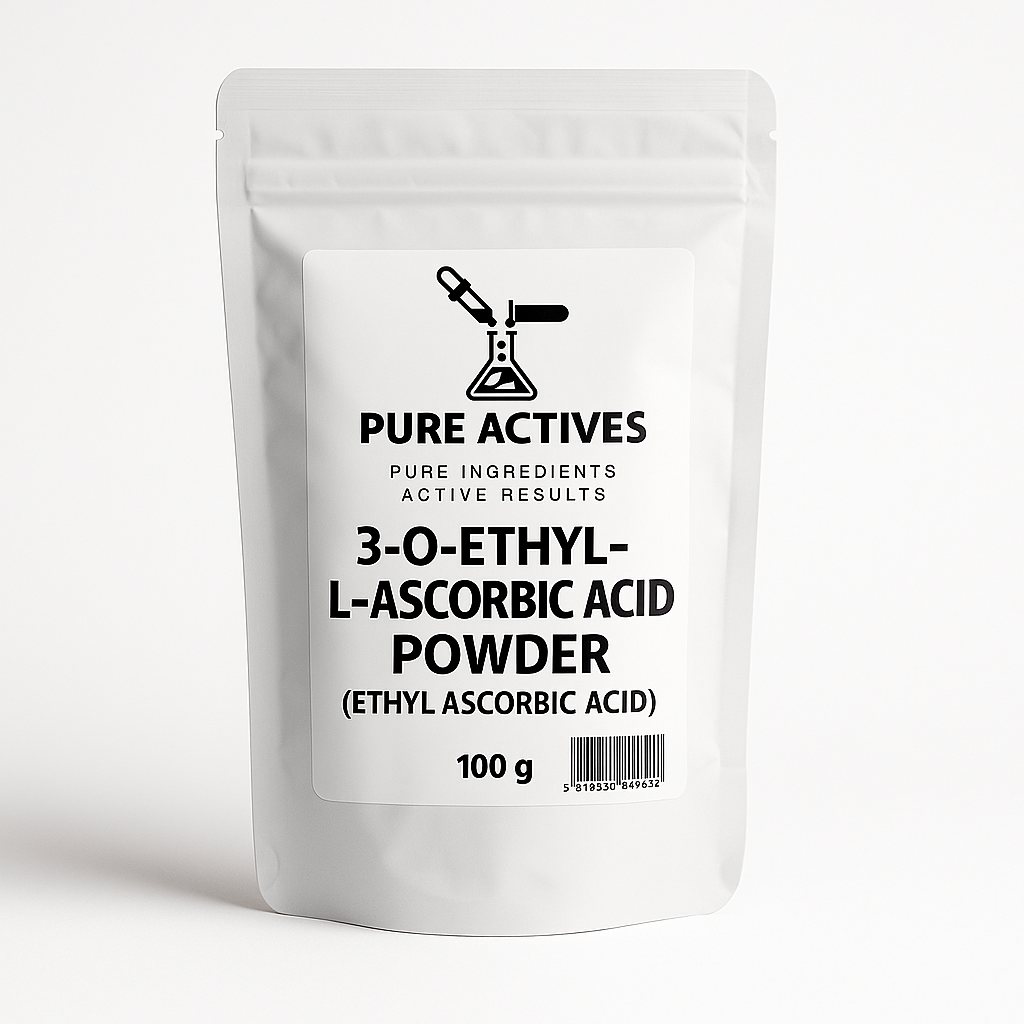
3-O-Ethyl-L-Ascorbic Acid (Stable Vitamin C)
Professional cosmetic ingredient — not a finished product.
Make high-performance Vitamin C serums that stay clear and effective for months — not days.
If you’ve ever watched a Vitamin C serum turn brown and useless within a week, you’ve experienced the core problem with L-Ascorbic Acid: it oxidizes rapidly on contact with air, light, and trace metals. 3-O-Ethyl Ascorbic Acid solves this at the molecular level. By etherifying the 3-position of the ascorbic acid molecule, this derivative resists oxidation while retaining the ability to convert back to active Vitamin C in the skin — delivering brightening, antioxidant, and collagen-stimulating benefits in a formula that stays stable for months.
What Is 3-O-Ethyl Ascorbic Acid?
3-O-Ethyl Ascorbic Acid (3-O-EAC) is a stable, water-soluble Vitamin C derivative where an ethyl group is bonded to the 3-position of the ascorbic acid ring. This modification prevents the rapid oxidation that makes L-Ascorbic Acid so difficult to formulate with, while the molecule retains its ability to be enzymatically converted to ascorbic acid in the skin.
Unlike L-Ascorbic Acid, which requires a pH below 3.5 for optimal efficacy and causes significant irritation at effective concentrations, 3-O-EAC is effective at a more skin-friendly pH of 4.0–6.0 and is well-tolerated even by sensitive skin. It is one of the most widely used stable Vitamin C derivatives in professional cosmetic formulation.
Key Specs
| INCI |
3-O-Ethyl Ascorbic Acid |
| CAS No. |
86404-04-8 |
| Appearance |
White to off-white crystalline powder |
| Solubility |
Soluble in water and ethanol; limited solubility in oils |
| Typical Usage Rate |
0.5–3% (brightening); up to 5% (intensive antioxidant/brightening) |
| pH Range |
4.0–6.0 preferred; optimal stability and efficacy at pH 4.0–4.5 |
| Processing |
Add at cool-down (below 40°C); avoid prolonged heat and alkaline pH |
| Stability |
Significantly more stable than L-Ascorbic Acid; use chelator + antioxidant for maximum shelf life |
| Grade |
Cosmetic grade; vegan-friendly |
Key Benefits
-
Stable Vitamin C delivery — resists oxidation that degrades L-Ascorbic Acid; formulas stay clear and active for months when properly stabilized with a chelator
-
Brightening & anti-hyperpigmentation — inhibits tyrosinase and reduces melanin synthesis; effective on dark spots, PIH, and uneven skin tone
-
Antioxidant protection — neutralizes free radicals and reactive oxygen species; protects skin from UV-induced oxidative damage when used alongside SPF
-
Collagen synthesis support — Vitamin C is a required cofactor for collagen cross-linking; supports skin firmness and reduces the appearance of fine lines over time
-
Skin-friendly pH range — effective at pH 4.0–6.0, significantly less irritating than L-Ascorbic Acid which requires pH <3.5; suitable for sensitive skin formulations
-
Water-soluble — easy to incorporate into aqueous serums, essences, and emulsions without the solubility challenges of oil-soluble Vitamin C derivatives
How to Formulate With It
-
Add at cool-down: Add 3-O-EAC to your formula at cool-down (below 40°C) to minimize heat-induced degradation. It dissolves readily in the water phase at this temperature.
-
Chelate first: Always include 0.1% Sodium Phytate or 0.1–0.2% Disodium EDTA in your water phase. Metal ions are the primary driver of Vitamin C oxidation — chelation is non-negotiable for stability.
-
pH adjustment: Adjust finished product pH to 4.0–4.5 using citric acid solution. This range optimizes both stability and efficacy. At pH above 6.0, degradation accelerates significantly.
-
Antioxidant support: Add 0.5% Vitamin E (Tocopherol) or 0.1% Ferulic Acid to the formula. These antioxidants synergize with Vitamin C and further protect against oxidation.
-
Packaging: Use opaque or UV-protective packaging. Light exposure accelerates oxidation even in stable derivatives.
Beginner tip: Start with a simple 2% 3-O-EAC gel serum — 0.1% Sodium Phytate in water, 0.4% xanthan gum dispersed in propanediol, add 3-O-EAC at cool-down, adjust pH to 4.2, preserve. This is a clean, effective, and stable formula that outperforms many commercial Vitamin C serums.
Stabilized Radiance Serum Formula
A professionally structured gel-serum. Difficulty: Intermediate | Yield: 100g
| Phase |
Ingredient |
% |
Weight (g) |
| A |
Distilled Water |
qs to 100% |
88.9g |
| A |
Sodium Phytate (Chelator) |
0.1% |
0.1g |
| B |
Propanediol 1,3 (or Glycerin) |
5.0% |
5.0g |
| B |
Xanthan Gum (Soft/Clear) |
0.4% |
0.4g |
| C |
3-O-Ethyl Ascorbic Acid |
5.0% |
5.0g |
| D |
Broad Spectrum Preservative |
0.5% |
0.5g |
| D |
Citric Acid (50% Solution) |
qs |
pH Adjust to 4.0–4.5 |
-
Phase A: Dissolve Sodium Phytate in distilled water. Stir until clear. This neutralizes metal ions that cause oxidation.
-
Phase B (Slurry): Disperse Xanthan Gum into Propanediol. Mix well to prevent clumping, then pour into Phase A. Stir until fully hydrated and gel forms.
-
Phase C: At cool-down (<40°C), add 3-O-Ethyl Ascorbic Acid. Stir gently until fully dissolved.
-
Phase D: Add preservative, then adjust pH to 4.0–4.5 with citric acid solution.
Applications
- Brightening serums and essences
- Antioxidant day serums (pair with SPF in finished routine)
- Anti-hyperpigmentation spot treatments
- Anti-aging formulas targeting collagen support and firmness
- Sensitive skin Vitamin C formulas (pH-friendly alternative to L-Ascorbic Acid)
Pairings & Suggested Formulas
-
Sodium Phytate — always pair with Sodium Phytate at 0.1% as your chelator; essential for Vitamin C stability
-
Niacinamide — combine with Niacinamide Vitamin B3 Powder for a brightening + barrier-repair serum; both are water-soluble and work synergistically on pigmentation and skin tone
-
Alpha-Arbutin — layer with Alpha-Arbutin for a multi-pathway brightening formula targeting tyrosinase inhibition from two angles
-
Ferulic Acid — add 0.1% Ferulic Acid to significantly boost antioxidant efficacy and Vitamin C stability; the classic CE+Ferulic combination
-
L-Ascorbic Acid — also available as L-Ascorbic Acid Powder for formulators who prefer the traditional, highest-potency form
Storage & Safety
Store tightly sealed in a cool, dry place away from direct light and heat. Shelf life: 24 months when properly stored. For external use only in finished cosmetic formulations. Not for internal use. Consult SDS before use.